
Portfolio Update
Portfolio Update (Nov 2026)
14 November 2026
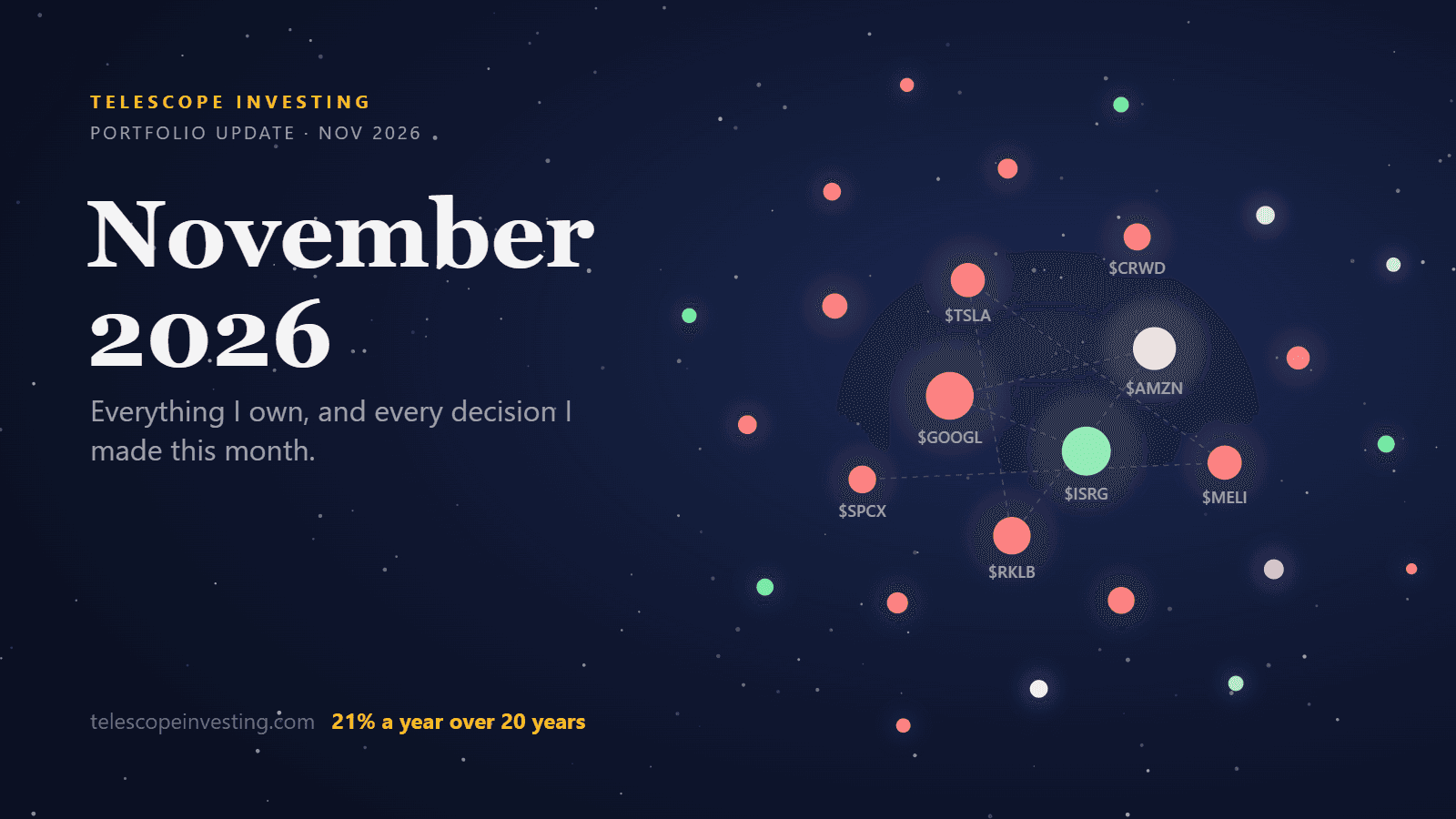
I've generated a 21% CAGR over 20 years by investing in world-class companies committed to shaping a better future. Here's everything I own today: [Nov 2026]
⭐ = high conviction ⬆️ = bought / added ⬇️ = trimmed / sold
- $CASH - Cash - 24.2%
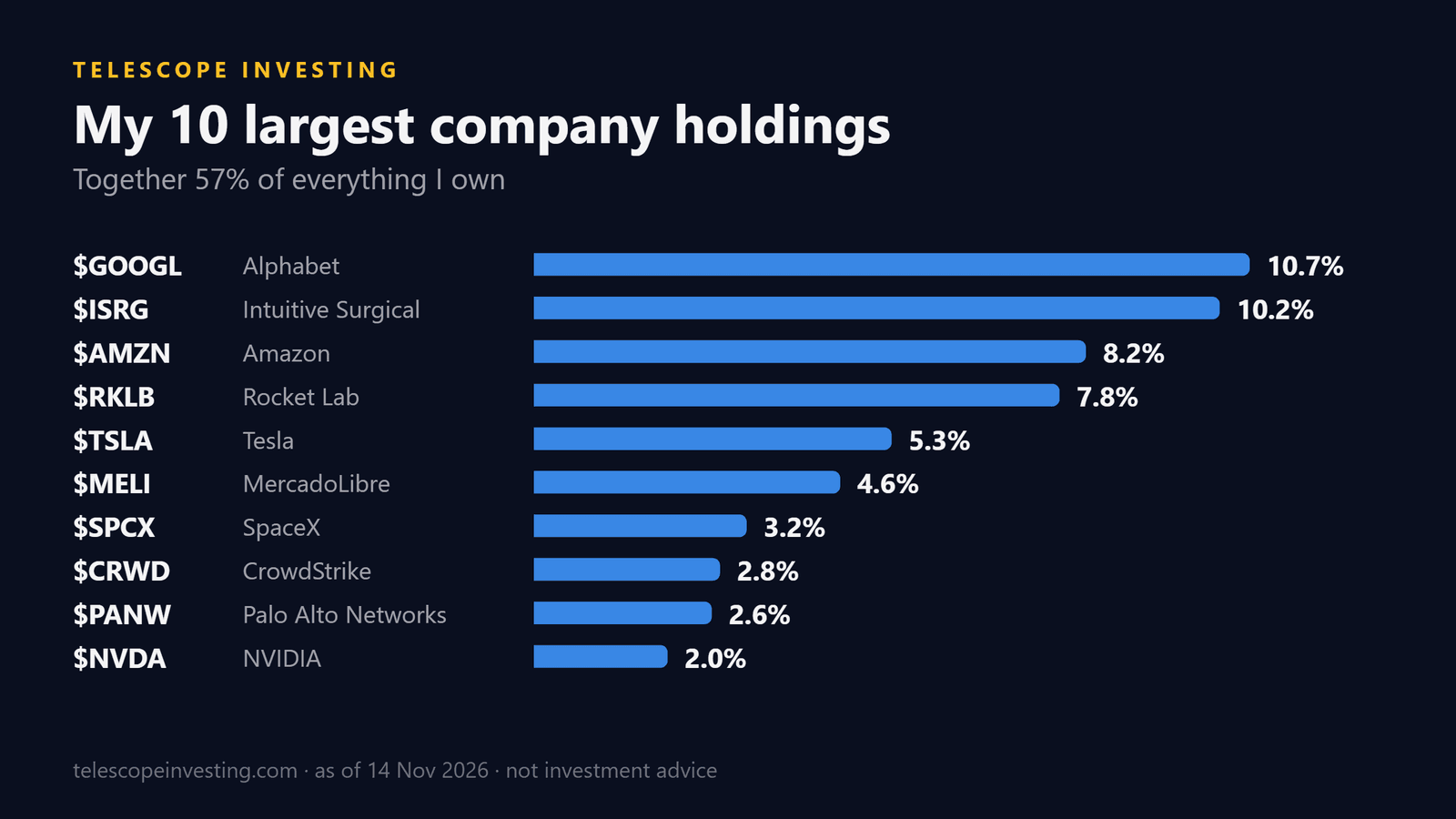
- $GOOGL - Alphabet - 10.7%
- $ISRG - Intuitive Surgical - 10.2%
- $AMZN - Amazon - 8.2% ⭐
- $RKLB - Rocket Lab - 7.8%
- $TSLA - Tesla - 5.3% ⭐
- $MELI - MercadoLibre - 4.6% ⭐
- $PRIVATE - Private companies (VC) - 4.3%
- $SPCX - SpaceX - 3.2% ⭐
- $CRWD - CrowdStrike - 2.8%
- $PANW - Palo Alto Networks - 2.6%
- $NVDA - NVIDIA - 2.0%
- $AXON - Axon - 1.5% ⭐
- $SE - Sea Ltd - 1.4%
- $TMDX - TransMedics - 1.3%
- $ASTS - AST SpaceMobile - 1.3%
- $UBER - Uber - 1.2%
- $NVO - Novo Nordisk - 1.0%
- $NU - Nubank - 1.0%
- $ADYEN - Adyen - 0.8%
- $GRG - Greggs - 0.8%
- $BN - Brookfield Corp - 0.8%
- $LMT - Lockheed Martin - 0.6%
- $IBE - Iberdrola SA - 0.6%
- $CWEN - Clearway Energy - 0.5%
- $CEG - Constellation Energy - 0.5%
- $BEPC - Brookfield Renewable - 0.5%
- $IREN - Iris Energy - 0.4%
- $NKTR - Nektar Therapeutics - 0.2%
Sold:
- $PLTR - Palantir ⬇️
This month the AI trade lost its most recognisable leader, and I came out of it with three changes: I sold the last of Palantir $PLTR, took the high-conviction star off NVIDIA $NVDA, and put one on SpaceX $SPCX. Each came down to a perennial question I try to ask myself: would I buy this if I didn't own it today?
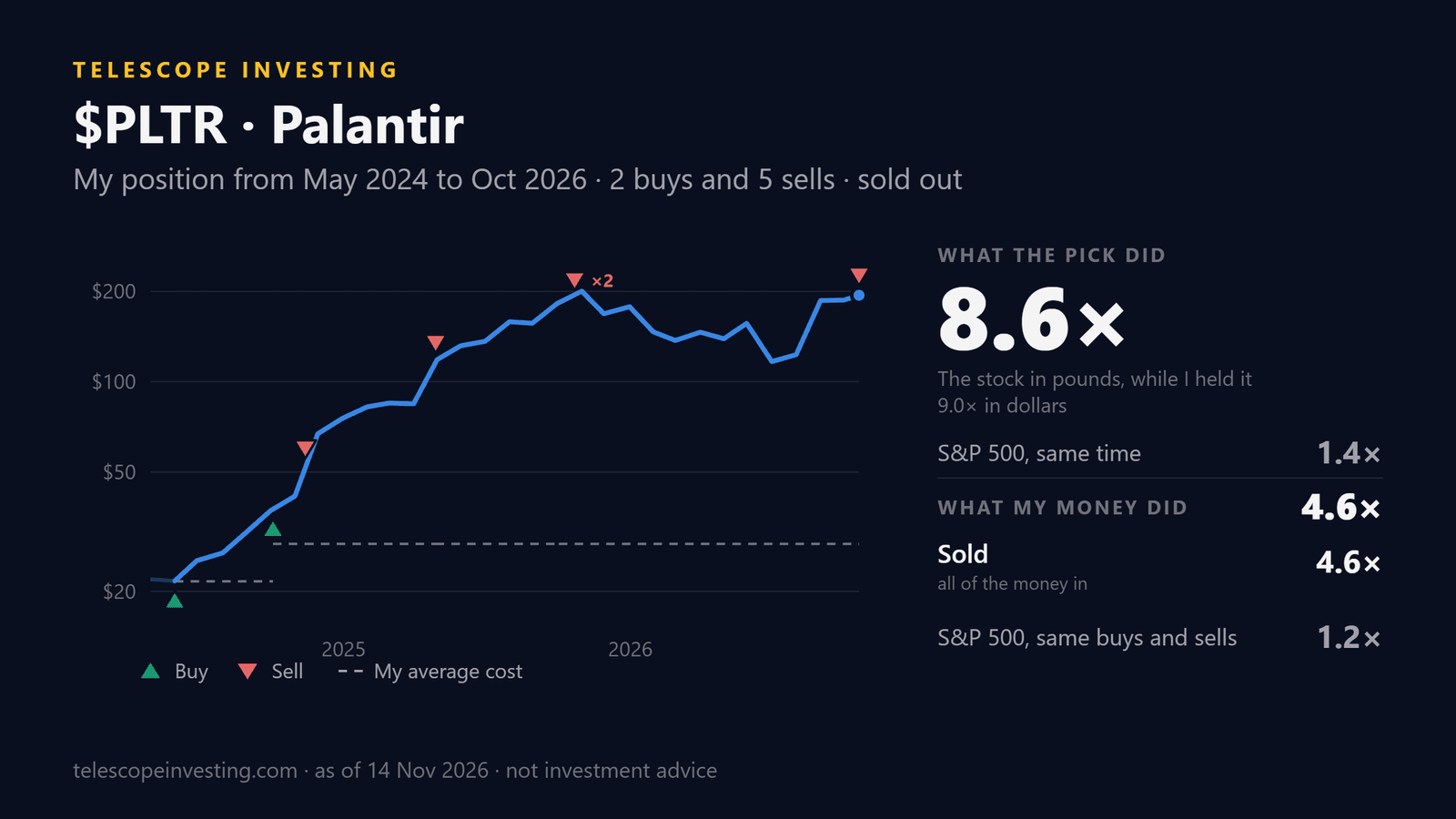
For Palantir, the answer was no. It's been a long goodbye: I trimmed $PLTR three times last year, each time on valuation - in May 2025 at around 200x free cash flow, in October 2025 when my reverse DCF said it needed to grow free cash flow by over 42% a year for a decade to justify the price, and again in November 2025. Through all of that I still believed in the business. This exit is different, and I've now sold the rest of the position.
What's changed is my view of the moat. Much of Palantir's edge rests on its deployment playbook, which the AI labs are now copying, and on an integration layer that coding agents are making cheap to build. Even if revenue growth holds up, the multiple may compress towards something closer to services-like economics. Government revenue looks better protected, but commercial growth may slow as mid-sized customers find they can build in-house, or turn to lab-led deployments using state-of-the-art models. It's the same pressure that put Zscaler and Salesforce on my "too hard pile" in May: AI is creating enormous value, but it can also erode the layer a software company sells.
For NVIDIA, the answer is not right now. Morality and politics aside, Jensen Huang's departure matters. I think American exceptionalism in AI will be impacted, and I expect the whole AI trade to slow. NVIDIA has carried a high-conviction ⭐ in every one of my updates this year, and I'm now removing it. I'm not selling at this time as I'd like to see who steps into the CEO seat, but at 2.0% of the portfolio it's now a potential sell for me.
There's a second brake on the trade, as it seems like the mid-term elections will likely impede future data centre growth. That helps companies that already have capacity, but I think it's going to be a longer-term drag on the whole sector, make life exceptionally difficult for the neocloud (I'm watching you, $IREN) and, to a lesser extent, the hyperscalers whose valuations depend on continued rapid growth.
For SpaceX, the answer is yes, with more conviction than before. Its strategy to deploy data centres in orbit is looking increasingly prescient. I'm expecting it to be at least ten years before the idea fully plays out, so this is a long-dated bet, but their ability to grow unconstrained by NIMBYism likely means they win in the long run, and nobody is close to being able to compete without their own launch capacity. SpaceX, at 3.2%, therefore becomes high conviction ⭐. It also sits alongside the plan I set out in June: my private-market stake vests to taxable cash at the end of this year, and I've been gradually building a public position to replace it. I plan to add to $SPCX again when markets open next week.
Outside those changes, the portfolio is unchanged. My high-conviction-at-today's-valuation list is now Amazon $AMZN, MercadoLibre $MELI, Tesla $TSLA, Axon $AXON, and SpaceX $SPCX.
The Palantir proceeds are sitting in cash for now, which takes it to 24.2% of the portfolio, still mostly in UK gilts and short-dated bond funds. That's a large allocation, and deliberately so: if the AI trade does slow, it lets me act on better valuations without having to sell core holdings.
So November came down to asking one question of three AI holdings, and getting three different answers. My view of the trend hasn't changed, but as I wrote in August, the economics have to land in the layer you actually own. This month I've moved away from the layers I think are exposed, an integration business the labs can copy and a chipmaker without its founder at the helm, and towards the one company that can build its data centres where no planning committee can reach them.
--
I believe in transparency and accountability, and post my full portfolio and returns every month. I also have a weekly podcast where I dive deeper into the rationale for all my trades.
In the latest episode, we discuss Jensen Huang's exit and what it means for NVIDIA in more detail.