
Portfolio Update
Portfolio Update (Aug 2026)
15 August 2026

I've generated a 22% CAGR over 23 years by investing in world-class companies committed to shaping a better future. Here's everything I own today: [Aug 2026]
⭐ = high conviction ⬆️ = bought / added ⬇️ = trimmed / sold
- $CASH - Cash - 20.3%
- $GOOGL - Alphabet - 11.8%
- $RKLB - Rocket Lab - 9.8%
- $ISRG - Intuitive Surgical - 8.8%
- $AMZN - Amazon - 7.8% ⭐
- $MELI - MercadoLibre - 5.3% ⭐
- $TSLA - Tesla - 4.2% ⭐
- $CRWD - CrowdStrike - 4.1%
- $PANW - Palo Alto Networks - 3.0%
- $SPCX - SpaceX - 3.0% ⬆️
- $ASTS - AST SpaceMobile - 2.8% ⬆️
- $AXON - Axon - 2.7% ⭐
- $NVDA - NVIDIA - 2.6% ⭐
- $SE - Sea Ltd - 2.2%
- $UBER - Uber - 1.2%
- $TMDX - TransMedics - 1.2%
- $IIND - India ETF - 1.1%
- $NVO - Novo Nordisk - 1.1%
- $IREN - Iris Energy - 1.0%
- $ADYEN - Adyen - 1.0%
- $PLTR - Palantir - 1.0%
- $NU - Nubank - 0.9%
- $LMT - Lockheed Martin - 0.6%
- $GRG - Greggs - 0.6%
- $BEPC - Brookfield Renewable - 0.5%
- $CWEN - Clearway Energy - 0.5%
- $IBE - Iberdrola SA - 0.5%
- $NKTR - Nektar Therapeutics - 0.4%
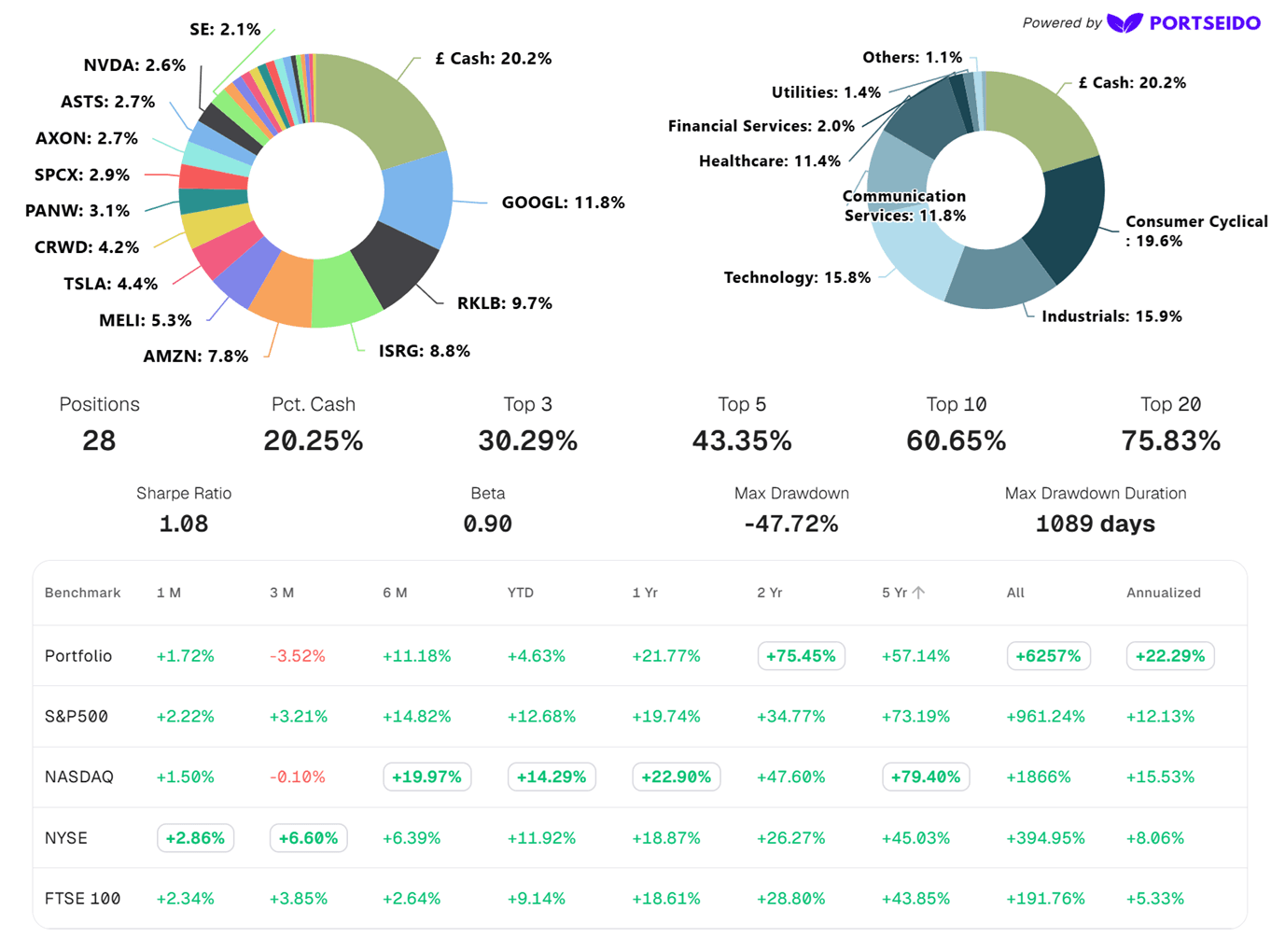
August is a small personal milestone: 23 years since I first started investing in 2003. Looking back over the last twenty years, I’ve compounded at 22.3% a year over that stretch, a cumulative +6258%. The same contributions, on the same dates, in the S&P 500 would have returned 12.1% a year, or +960% - leaving me with roughly a fifth of where I've ended up. A UK savings account, with Bank Rate at or below 0.5% for twelve of those years, would have been a loss in real terms after inflation. That gap is the whole reason I care so much about staying invested, learning in public, and letting exceptional businesses do the heavy lifting over time.
I've always invested around megatrends, sectors positioned to grow as society increasingly recognises their importance. Identifying the trend itself is rarely the hard part. In the mid 2000s you didn't need special insight to know that broadband, mobile and eventually cloud computing were going to be enormous. The money isn't in spotting the trend; it's in the lag between a thing being important and being priced as important. That gap is where a patient investor with a long horizon actually gets paid, and it closes a little further every year the consensus catches up. Being right about the trend is not the same as making money from it though - the economics have to land in the layer you actually own, and at a price that doesn't already assume the recognition you're waiting for.
As I look back over the decades, what megatrend thinking really buys me is a reason to hold. Concentrated portfolios fail on wrong theses often enough. They fail just as often on a holder who ran out of conviction during a 60% drawdown, and that failure mode gets far less airtime. If your reason for owning something is a chart or a quarter, you'll sell it at the worst possible moment. If your reason is a fifteen-year structural shift that hasn't shown up in the stock price, the drawdown is noise - expensive, uncomfortable noise - but noise. Over 23 years, the majority of my returns came from a handful of positions I simply didn't sell, and the megatrend framing is what made not-selling survivable.
The main megatrend area I added to this month was space.
My reported SpaceX $SPCX allocation is now 3.0%, but most of that is still the private-market stake I bought in 2024. My public-market SpaceX allocation remains sub 1%, although I’ve been buying steadily through early August at improving valuation points. I would still like to build my public exposure gradually, linked to the private-market SpaceX shares I expect to vest into taxable cash later this year, but I want to handle that transition deliberately rather than scrambling at the last minute.
After recording a massive six hour deep dive podcast episode on AST SpaceMobile, I added to my own $ASTS position this month, bringing it up to 2.8% of my retirement portfolio. There is still plenty of execution risk here, but some of the technical risk has reduced now that the company has successfully deployed seven of their largest Block 2 satellites to orbit, the direct-to-device model is strategically interesting, and the regulatory environment may be more supportive than the market gives it credit for. This is still a venture-style position, but I want more exposure than I previously had.
That means that space is now a major theme in my portfolio across three very different expressions: Rocket Lab $RKLB at 9.8%, SpaceX $SPCX at 3.0%, and AST SpaceMobile $ASTS at 2.8%. I’m comfortable with that, but it’s also why position sizing matters. I don’t want one single name to dominate the portfolio, even when I like the long-term thesis, and spreading the exposure across launch, space infrastructure, and satellite connectivity feels like a cleaner way to express the broader theme.
I have not touched Rocket Lab $RKLB since the earlier trims, and it remains just under 10% of the portfolio. That feels about right for now. I still like the long-term setup, but the lesson from last year is that conviction and risk management have to coexist. A great business can still become an uncomfortable portfolio decision if the allocation gets too large.
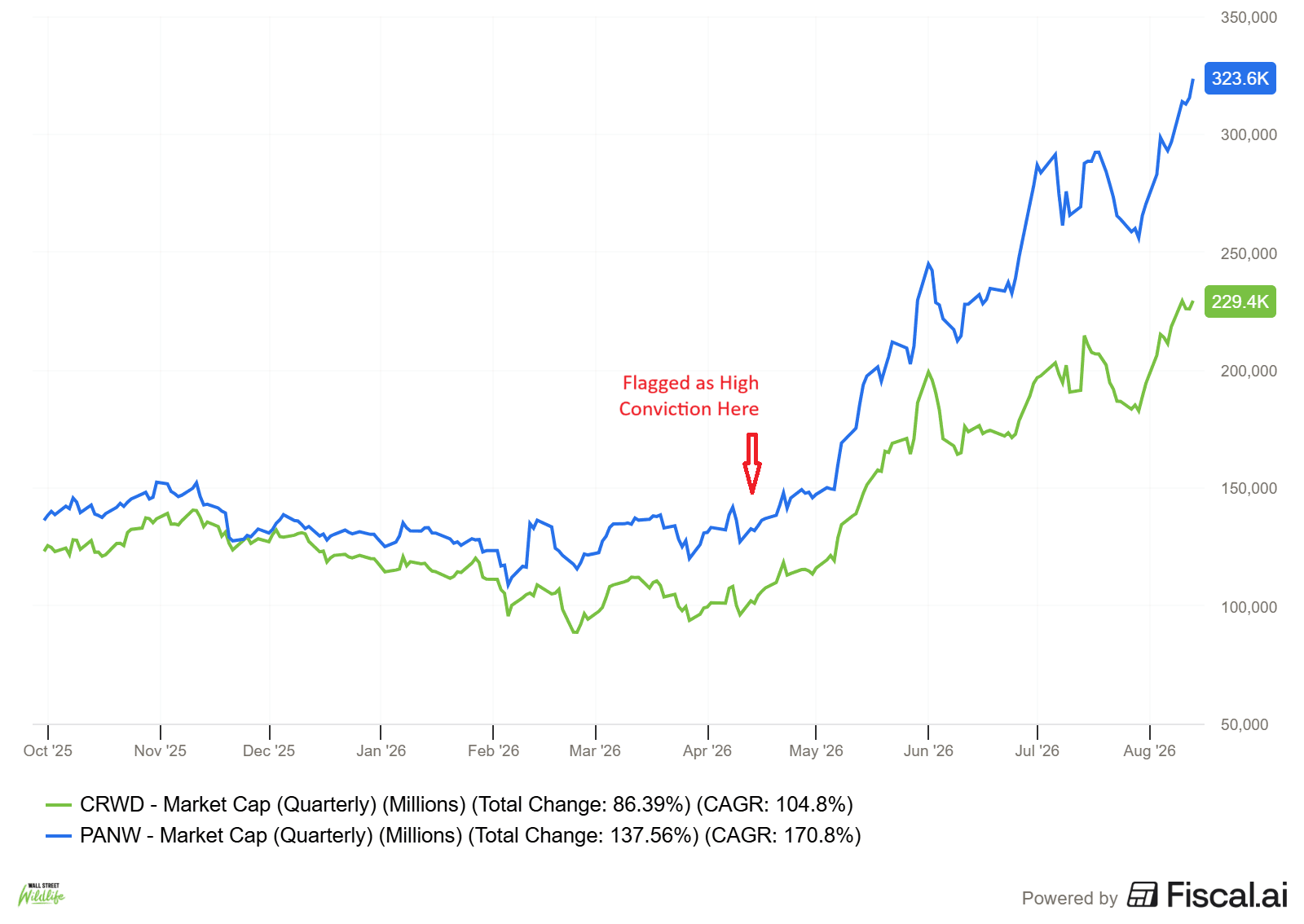
Coming back to Earth, this month I’m also removing my “high-conviction-at-current-valuation” ⭐s from CrowdStrike $CRWD and Palo Alto Networks $PANW. This is primarily valuation discipline rather than a thesis break. I re-added the stars in April 2026 because I thought cybersecurity was one of the cleaner AI-adoption winners, and that call has worked almost uncomfortably well - since that April update, both stocks are up roughly 130%! I actually regret not eating my own dog food and adding to both positions at the time, but both businesses still look excellent, even though their prices now do a lot more of the talking. I do not (currently) plan to trim.
Outside of space and cybersecurity, my portfolio is mostly unchanged. The current high-conviction list at today's valuation is Amazon $AMZN, MercadoLibre $MELI, Tesla $TSLA, Axon $AXON, and NVIDIA $NVDA. That is not a claim that these are cheap in an absolute sense, but they are still the names where I feel the best combination of business quality, long-term optionality, and current valuation.
So the short version is: still cautious, but not frozen. I’m holding a meaningful cash balance, avoiding the temptation to force capital into average ideas, and selectively adding where the thesis has strengthened or the price has improved. That feels like the right posture for this market.
--
I believe in transparency and accountability, and post my full portfolio and returns every month. I also have a weekly podcast where I dive deeper into the rationale for all my trades.
To catch the latest episode, search for "Wall Street Wildlife" on your podcast platform of choice, or find us on YouTube.
